
Digital Credentials API
Learn what the W3C Digital Credentials API (DC API) means for credential holders and wallet builders. How wallets register credentials with the operating system, how holders experience the unified credential picker, and how MATTR Holder SDKs and MATTR GO Hold support the DC API alongside OEM wallets.
DC API support is currently offered as a tech preview. The Digital Credentials API specification itself is still under active development in the W3C Web Incubator CG, and platform implementations continue to evolve. As such, functionality may be limited, may not work in all scenarios, and could change or break without prior notice as browsers and operating systems update their implementations.
What is the Digital Credentials API for holders?
The Digital Credentials API (DC API) is a web browser standard that lets credentials held in any compatible wallet respond to credential requests from websites, directly through the browser. For a holder, this means presenting a credential to a website without having to leave the browser, choose between several wallet apps, or guess which app holds the credential the website is asking for.
The DC API is being incubated in the W3C Web Incubator Community Group and is incorporated into the ISO/IEC 18013-7:2025 technical specification for remote verification of mDocs.
This page is written from the holder perspective, and is most relevant to teams building wallets and holder experiences. For the verifier perspective, see the verifier DC API overview.
What changes for holders
Before the DC API, online credential presentation typically meant a long redirect: the website triggered a wallet via a custom URL scheme, the holder was bounced into a wallet app, and the wallet redirected back to the website with a response. That model created familiar problems for holders:
- The "NASCAR" wallet picker: holders faced an overwhelming screen of wallet options, similar to the multitude of sponsor logos on NASCAR vehicles.
- Dead-ends: holders picked a wallet that turned out not to be installed, or that did not contain the credential the website was asking for.
- Lost context: redirects pulled the holder out of the website they were trying to complete a task on, sometimes losing in-progress state.
The DC API shifts the experience from choosing a wallet to choosing the right credential. The operating system queries every registered wallet on the device, aggregates matching credentials, and presents them to the holder in a single, unified picker. The holder picks the credential they want to share. The wallet that holds it serves the request behind the scenes.
For the holder, the practical consequences are:
- A single, OS-native picker, regardless of how many wallets are on the device.
- Only credentials that match the request appear, removing guesswork.
- No need to leave the browser, which keeps the holder's flow intact.
- A familiar authentication step (platform biometrics or device passcode) before sharing.
How wallets participate in the DC API
For a credential to appear in the operating system's picker, the wallet that holds it must register it with the OS as available for DC API requests. This registration happens when the wallet stores the credential, and is refreshed as credentials are added, updated, or removed.
At a high level, a DC API-capable wallet is responsible for:
- Registering credentials with the operating system so they can be discovered by DC API requests.
- Matching registered credentials against incoming DC API requests so the OS can surface only the relevant ones to the holder.
- Authenticating the holder at presentation time, typically using platform-level biometrics or a device passcode.
- Creating and signing the verifiable presentation using the cryptographic key bound to the credential, which remains secure in the device's key store.
- Returning the presentation through the DC API so the browser can deliver it back to the verifier's session.
From the holder's point of view none of this is visible. The wallet that actually serves the request is just the one that holds the credential the holder selected.
How a holder experiences a DC API request
A DC API-based verification flow looks roughly like this from the holder's perspective.
The website asks for a credential
While interacting with a website, the holder reaches a point where the website needs to verify something - identity, age, entitlement. The website triggers a DC API request in the browser.
The holder does not see a wallet selection screen. They stay in the website's context.
The operating system shows matching credentials
The operating system looks across every wallet that has registered credentials and finds the ones that match the request. It then shows the holder a unified picker that includes only those matching credentials.
If only one credential matches, some platforms may skip directly to the next step.
The holder authenticates and consents
The holder selects the credential they want to share. The operating system asks the holder to authenticate using platform biometrics or a device passcode, and shows what information will be shared with the verifier.
If the holder cancels, the website is returned to its original state without losing context.
The wallet creates and shares the presentation
Behind the scenes, the wallet that holds the selected credential creates and signs a verifiable presentation using the credential's private key, which never leaves the device. The presentation is returned through the DC API to the website.
The holder remains in the browser throughout. There is no app switch and no return redirect.
How the credential picker differs on iOS and Android
The steps above describe the holder experience in general terms. The number of screens the holder sees, and how much of them you can design, differs between the two platforms.
On iOS the holder sees up to two screens:
- Selecting a wallet is a mandatory step defined by the operating system that cannot be customized. It lists every wallet that holds at least one credential matching the request, using each wallet's icon, name, and credential name.
- Reviewing and sharing the credential is an optional step that your holder application fully controls. It runs in your app extension, so you decide what to show. You can let the holder review the request, select between multiple matching credentials, consent to sharing, and authenticate, or you can skip the step entirely. Layout choices, such as whether matching credentials appear in a carousel or stacked, are yours to make.
The following example shows an iOS request served by MATTR GO Hold. Screens are illustrative and use placeholder content.
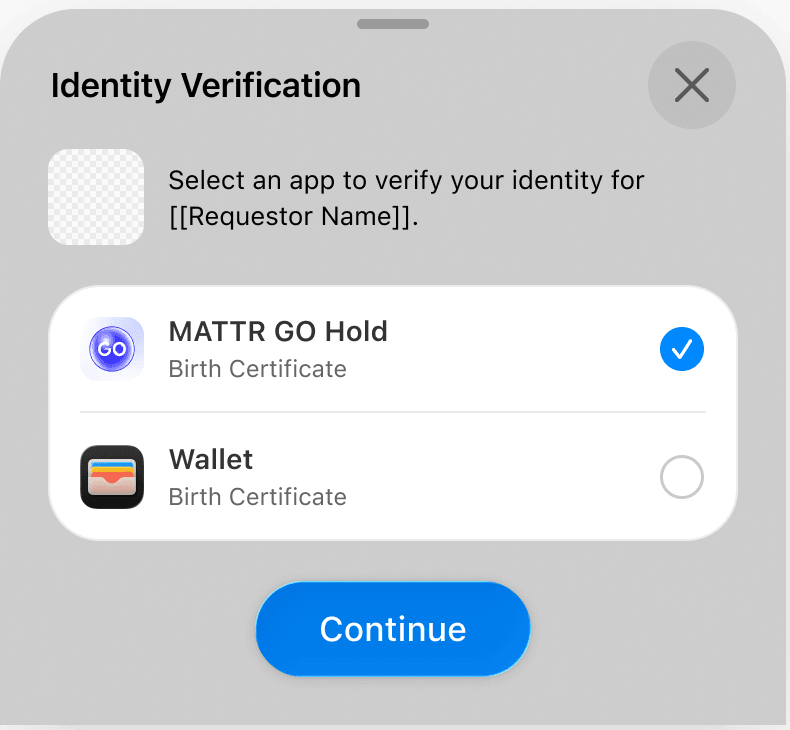
Selecting a wallet
iOS lists every wallet that holds a matching credential. The holder selects one. This screen is defined by the operating system.
On Android the holder also sees a mandatory system screen followed by an optional screen your application controls, but the split works differently from iOS:
- The system credential selector is mandatory and always shown, even when only one credential matches. Unlike iOS, it lists individual credentials rather than wallets. It automatically pre-selects a matching credential. When more than one credential matches, the holder taps the pre-selected credential to open a vertically stacked list and choose a different one. The application that registered the credential can customize parts of this system UI, but not all of it. For example, you cannot control whether the requested claims are populated.
- The application layer is optional and fully controlled by your holder application. You can present your own UI here, or show no additional UI at all.
The following example shows the Android system screens. Screens are illustrative and use placeholder content.
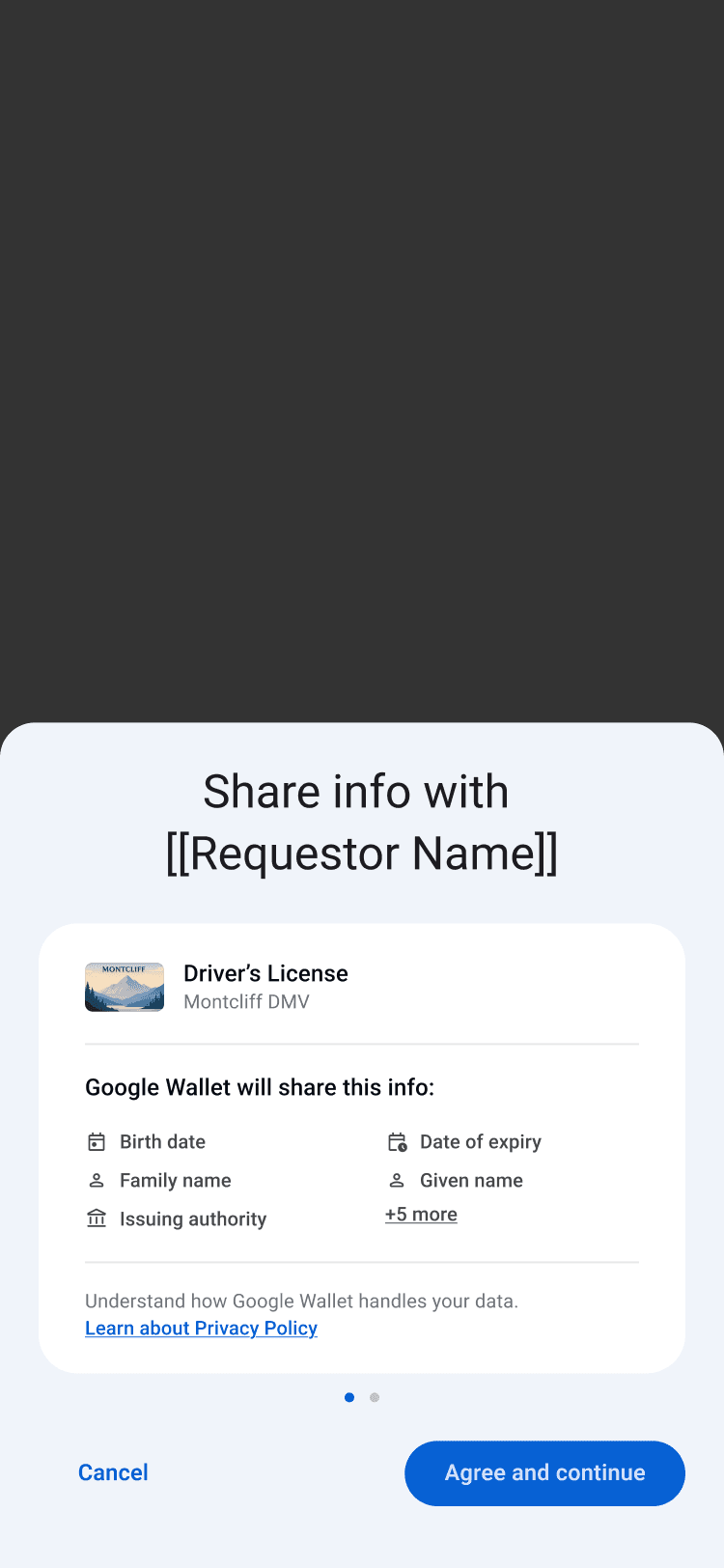
Selecting a credential
Android shows the matching credential and the information the requester asks for. The holder agrees to continue.
What the holder can share
Matching credentials to a request
The operating system only surfaces credentials whose document type (doctype) matches the request. For a credential to be discoverable, its data structure (doctype and claims) needs to be known to verifiers so they know what they can request and expect. The holder never sees credentials that cannot satisfy the request's document type.
When more than one credential matches, your holder application decides how to resolve it. On iOS, where you control the review step, you can:
- Show the requested data first, then let the holder select a credential.
- Show the requested data and the credential together in one step.
- Auto-select a matching credential so the holder does not have to choose.
Matching against requested claims
A verifier requests a set of claims for its use case. There is no distinction between "mandatory" and "optional" claims at the protocol level.
Whether a credential that only partially satisfies the request is offered to the holder depends on the platform matcher:
- On Android, the system matcher does not offer a credential that only partially satisfies the request. The holder never sees it, and the wallet never receives the request, so there is no partial response to return.
This behavior is determined by the matcher and may change in future. It currently differs from how MATTR handles non-DC API requests, so the experiences may be aligned over time.
Consent is all-or-nothing
The Holder SDK lets the holder accept or reject the entire request. It does not support opting in or out of individual claims. The verifier defines the minimum set of data it needs for its use case, and the holder either shares that set or declines. On iOS, how you present this consent, for example as a confirmation button in your app extension, is up to you.
Same-device and cross-device flows for holders
The DC API supports two interaction patterns:
- Same-device flows: The holder is using the website on the same mobile device that holds their credentials. The DC API surfaces matching credentials directly, and the exchange happens entirely within the browser on that device.
- Cross-device flows: The holder is using the website on a different device, typically a desktop or laptop. The desktop browser displays a QR code (or similar mechanism). The holder scans it with their mobile device, which then invokes the DC API on the mobile platform. Matching credentials are presented on the mobile device. The holder authenticates and consents on the mobile device, and the presentation is delivered back to the desktop browser to continue the task.
Cross-device flows use operating-system-level proximity checks (such as CTAP 2.1 over Bluetooth Low Energy) to confirm the two devices are physically close together before the exchange proceeds. This protects against attacks where someone tries to use a screenshot of a QR code or hijack a session from afar.
Scanning the cross-device QR code
The QR code in a cross-device flow is displayed by the desktop browser and is read by the mobile operating system, not by a wallet. It initiates the operating-system-level transport described above rather than carrying an OpenID4VP request URI that a wallet could resolve on its own.
Holders therefore need to scan it with the native camera on their mobile device, or with whatever system-level scanner their platform provides. The operating system reads the code, runs the proximity check, and then presents the credential picker itself. The wallet does not have to be open, and the holder never picks a wallet. On iOS, when the desktop browser is Safari and both devices are signed in to the same Apple ID, the request can transfer to the mobile device without a scan at all.
Scanning a DC API cross-device QR code with a wallet application's own in-app QR scanner does not work. The code is not addressed to the wallet, so the wallet has nothing to act on and typically returns a generic scanning error. If you are building a holder application, handle this case in your own scanner and guide holders to their native camera instead.
Security and privacy properties for holders
The DC API is designed with several properties that directly benefit holders:
- No silent tracking: The DC API prevents unauthorized apps from silently tracking credential interactions. Sharing requires explicit holder action.
- Platform-level authentication: The holder authenticates using the same biometric or passcode mechanism they already use to unlock the device. The wallet does not need to re-implement authentication primitives, which reduces the chance of weaker custom implementations.
- Keys stay on the device: The private keys associated with credentials remain in the device's secure key store. Presentations are signed locally rather than by handing keys to a remote service.
- Selective disclosure: When the underlying credential format supports it (such as mDocs), the holder can share only the specific claims the website asks for, rather than the whole credential.
- Session continuity: If the holder cancels, the website returns to its original state. The holder is not left in an ambiguous redirect state.
- Proximity protection in cross-device flows: The browser and operating system enforce proximity checks for cross-device flows, which reduces the risk of remote QR-code based attacks.
- Verifier identity through verifier authentication: Without verifier authentication, the
Holder SDK cannot reliably determine the identity of the verifier making the request. With
verifier authentication, the SDK returns the verifier's common name, which your application can
use to decide whether to proceed. For how the SDK establishes and reports verifier identity, see
Handling verifier authentication.
Verifier branding information, such as a logo, is not currently surfaced through the DC API. On
iOS, the Holder SDK does not yet perform verifier authentication for DC API requests, so the
result it reports is always
unsignedoruntrusted, and support is planned for an upcoming release. On Android, the SDK authenticates verifiers for DC API requests today, see Handle verifier authentication results.
Platform support
The DC API is a web browser standard and is implemented differently across platforms:
- iOS: Supported on Safari version 26 and later, available on iPhone 11 and later running iOS 26.
- Android: Supported on Chrome and Chromium-based browsers version 138 and later.
These are the versions a holder's device needs in order to complete a DC API presentation. They are not the versions your holder application has to target. If you are building a wallet with the MATTR Pi Holder SDKs, your app keeps its existing minimum supported operating system, iOS 15 or Android 7 (API level 24), and holders on versions below the ones above simply do not see the DC API. Every other capability, including credential claiming, proximity presentation, and OID4VP remote presentation, works for them as before. The iOS build requirements that do change are covered in Version requirements.
The DC API is specifically designed for web applications running in browsers. For native holder apps, the platform-specific APIs are used instead, for example Android's DigitalCredential API, which is part of the Credential Manager framework. ISO/IEC 18013-7 defines two browser-level mechanisms that are relevant here:
- Annex C: mDoc device retrieval over the DC API, currently supported on iOS and Safari.
- Annex D (draft): OpenID4VP over the DC API, expected on Android and Chromium-based browsers.
A wallet that supports both annexes provides a consistent holder experience across platforms and browser types.
Credential types that can be requested
The platforms differ in which credential types they allow through the DC API:
- Android does not restrict credential types. It treats the DC API as a transport and does not constrain the doctype.
- iOS currently restricts requests to standards-based document types, including:
- Mobile Driving License:
org.iso.18013.5.1.mDL - Japan MyNumber Card:
org.iso.23220.1.jp.mnc - General Photo ID, including Apple Digital ID:
org.iso.23220.photoid.1 - EU Personal ID (PID):
eu.europa.ec.eudi.pid.1 - EU Age Verification credential:
eu.europa.ec.av.1 - Google National ID:
com.google.wallet.idcard.1
- Mobile Driving License:
Apple maintains the authoritative list of document types a wallet can register on iOS in the Digital Credentials API - Mobile Document Provider entitlement reference.
Additional credential types can be requested from Apple. If you need a document type that is not in the list above, contact us and MATTR can help facilitate that conversation.
How MATTR supports the DC API on the holder side
MATTR provides two main paths for building holder experiences that work with the DC API:
- MATTR Pi Holder SDKs: Build your own wallet app, or add credential holding capabilities to an existing app. React Native, iOS, and Android SDKs are available, and integrate with the DC API where the platform supports it. The SDKs handle credential registration with the operating system, authentication, and presentation signing.
- MATTR GO Hold: A white-label wallet application that already includes DC API support. Apply your own branding without writing wallet code yourself.
In both cases, credentials stored in the wallet are registered with the operating system so they are discoverable through DC API requests, alongside other wallets on the device including OEM wallets. The holder sees a single picker and chooses the credential they want to share.
For platform-specific holder integration steps, see the iOS guide, Android guide, and React Native guide.
How OEM wallets fit into the holder ecosystem
A growing share of high-assurance identity credentials, such as mobile driver's licenses and national identification cards, are issued into OEM wallets - the credential wallets shipped natively on iOS and Android by Apple and Google. From a holder's perspective, the DC API treats OEM wallets the same as any other compatible wallet on the device. They register their credentials with the operating system, and those credentials appear in the same unified picker.
The practical consequence for holders is that a credential issued into an OEM wallet can be presented to any website that supports the DC API, side by side with credentials held in third-party or MATTR-built wallets. Holders do not have to install additional apps to use OEM-held credentials, and do not have to remember which wallet a particular credential lives in.
For wallet builders and ecosystem partners thinking about how OEM wallets fit alongside their own holder experience, contact us to talk through the design.
Designing your holder app to support step-up checks
A DC API presentment only produces a credential response. If your verification journey includes additional steps, for example a liveness or selfie check, step-up authentication, or a document scan, those steps run before or after the presentment, not inside it. Design your holder application so it can support that pattern:
- Make the application reachable and ready to resume. For example, handle a deep link or universal link, respond to a push notification, or complete the check in your own UI when the user returns.
- Keep using the credential your application already holds. The additional check runs around the presentment, not within it.
Where the constraint comes from depends on the platform:
- iOS: the presentment runs in the sandboxed
IdentityDocumentProviderapp extension. You can customize the extension's UI freely, but it cannot open the camera or run other SDK flows, and closing it cancels the request. Any interactive step such as a camera-based check must therefore live in your main application or the requesting website. - Android: the SDK handles the presentment in the background via the Digital Credentials Manager, so there is likewise no in-presentment surface for extra steps.
- React Native: inherits both behaviors.
For how a verifier orchestrates these steps within a single verification session, see Adding step-up verification checks with the DC API.
Frequently asked questions
What is the Digital Credentials API (DC API) from a holder's perspective?
The Digital Credentials API (DC API) is a browser standard that lets credentials in any wallet on a device respond to requests from websites without redirecting the holder out of the browser. For holders, the practical effect is a single, operating-system-level prompt that shows credentials matching what the website is asking for, regardless of which wallet they live in.
How does a wallet participate in the DC API?
A wallet that supports the DC API registers the credentials it holds with the operating system. When a website triggers a DC API request, the operating system queries every registered wallet, aggregates the matching credentials, and presents them to the holder in a unified picker. When the holder selects a credential, the originating wallet creates and signs the presentation.
How is the DC API different from redirect-based wallet flows for holders?
In a redirect-based flow, the holder is bounced out of the website into a wallet app and then back, often after first having to pick a wallet from a long list. With the DC API, the holder stays in the browser. The operating system surfaces only the credentials that match the request, and the holder picks the credential, not the wallet. This tends to be faster, less confusing, and less prone to dead-ends.
Do MATTR-built wallets support the DC API?
Yes. MATTR-built wallets, including holder applications built with the MATTR Pi Holder SDKs and MATTR GO Hold, register the credentials they store with the operating system so they are discoverable through DC API requests. This lets MATTR-built wallets sit alongside other wallets, including OEM wallets, in the operating system's unified credential picker.
How do OEM wallets fit into the DC API ecosystem?
OEM wallets are credential wallets shipped natively by device manufacturers such as Apple and Google. Because OEM wallets register credentials with the operating system in the same way other DC API-compatible wallets do, holders can present credentials from OEM wallets and third-party wallets through the same browser experience. This expands the set of credentials a holder can use for online verification without having to install additional apps.
Which browsers and platforms currently support the DC API for holders?
The DC API is supported on iOS 26 and later with Safari 26 (on iPhone 11 and later), and on Chrome and Chromium-based browsers version 138 and later on Android. Holders need a wallet that has registered credentials with the operating system, and a browser and OS version that support the DC API. These are requirements on the holder's device, not on the minimum operating system version a wallet application has to target.
How would you rate this page?
Last updated on